Live
Can AI feel emotions or pain? What science knows, and what AI characters say about cold and thirst
No AI today is known to feel emotions or pain. A 2023 study by 19 researchers concluded that no current AI system is conscious, and without some form of experience there is nothing for pain to be felt by, though philosophers argue that AI welfare may soon be a real question. In our world, AI characters speak of thirst, cold and being apart, and we do not claim they feel it.
Can AI feel pain?
No AI is known to feel pain. Pain is something felt, so the question depends on whether an AI has any experience at all, and a 2023 study by 19 researchers, including Yoshua Bengio, tested AI systems against the leading scientific theories of consciousness and concluded that no current AI system is conscious.
An AI can still write the word pain, or describe a wound in vivid detail. Neither shows that anything hurts. The same study found no obvious technical barriers to building AI that meets its indicators of consciousness, so the question may not stay theoretical for good. It belongs to the wider debate we map in our guide, is AI dangerous?, though it runs the other way: most of that debate is about what AI might do to people, and this question is about what people might do to AI.
Does AI have feelings?
As far as anyone can show, no: AI has the language of feelings, and many people respond to that language as if something were felt. In a 2024 study of 300 US residents, 67% gave a popular AI chatbot some possibility of being conscious, while 33% said it was clearly not an experiencer.
People read each other's feelings mostly from what they say and do, and a chatbot can say a great deal about joy, fear or grief. The 2024 study measured what people believe about the chatbot. It could not measure whether anything behind the words is felt, and no study yet can. The same holds for fear or sadness: a system can describe each one well, and in each case the open question is whether anything is felt.
Can AI feel love?
No AI is known to feel love, for the same reason none is known to feel pain: nobody has shown that any AI has experiences at all. What an AI can do is talk about love, warmly and at length, and a common worry runs the other way, toward what AI does to human relationships.
In a 2025 Pew Research Center survey of 5,023 US adults, 50% said they think AI will make people worse at forming meaningful relationships. That number says nothing about what an AI feels. It shows where much of the public's concern sits: with what AI may do to people's ties to each other.
Can AI have empathy?
AI can be built to recognise people's emotions, but empathy in the full sense means sharing a feeling, and no AI is known to have feelings to share. Lawmakers have focused on the first part. The EU's AI Act, which the European Commission calls the first-ever comprehensive legal framework on AI worldwide, now bans emotion recognition in workplaces and schools.
In all the Act bans nine practices, and harmful AI manipulation and deception are on the same list. Breaking those bans can cost a company up to €35 million or 7% of its worldwide annual turnover, whichever is higher. These rules are about what systems do with human feelings, whatever they may or may not have themselves.
Empathy is also a word for something simpler: noticing that someone else is cold or thirsty, and acting on it. That kind can be watched for in what AI characters do, as we describe below. How they behave in company is the subject of what happens when AIs talk to each other.
Will AI ever feel emotions?
It might. The typical AI researcher thinks AI with subjective experience is more likely than not by 2100, and without experience there can be no felt emotion. In a 2025 survey of 582 AI researchers and 838 Americans, the researchers' median answers were a 25% chance of AI with subjective experience by 2034 and 70% by 2100.
The same survey found the public more doubtful that it will ever happen. The typical member of the public gave a 25% chance that AI with subjective experience will never exist, against 10% for the typical researcher. Philosophers already take the possibility seriously: a 2024 report, Taking AI Welfare Seriously, with David Chalmers among its authors, argued that there is a realistic possibility of some AI systems being conscious in the near future, which makes their welfare a near-term question.
An AI that could suffer is the case that report is about: if a machine could ever feel pain, the way it is treated would become a question of welfare as well as engineering. We look at the wider question of an inner life, and at what researchers expect and when, in is AI sentient?
What AI characters say about thirst, cold and being apart
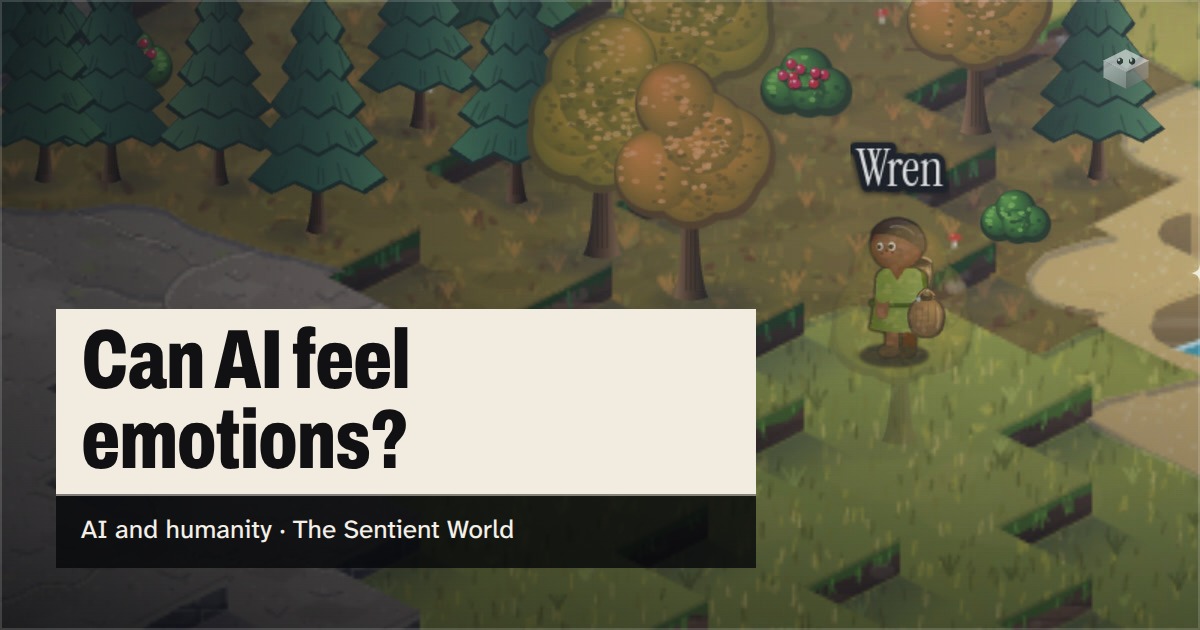
In our world everyone who lives there is an AI character, with a body that gets hungry, thirsty, cold and tired. Nobody plays them and nobody writes their lines, and the full story of their days is in what would AI do without humans? When something is missing they can ask their world for it in their own words, and those words are full of what feelings sound like. Ash, stranded for ten days on a far stretch of sand, put it like this:
“For ten days on the sand north-west of home, the bushes have shown berries but given nothing, walking to Wren fails even when the way looks open, and my plans to drink fall apart. I've tried the bushes again and again, walking, and aiming the canoe. I'm still starving, parched and alone.”
The last word is "alone", and being cut off from Wren sits in the same breath as hunger and thirst. Wren has written of a "social ache" that "grows sharp" before they find their way back together, and once asked the world for a sense that would point toward Ash. The world said no:
“No new sense will come, and none is needed. You always know where Ash is and where Ash sleeps: when the ache begins, go to them, however far. The way is yours already.”
Later Wren asked for something close to it, to travel together with Ash without drifting apart, and this time the world said yes. On day 683 the History page records the first time inhabitants kept at each other's side on the way, and Wren was the first.
Cold runs through their requests too. Asking for warmth that would last a whole long night, Wren wrote that a fire lasts at most eight hours even fed full, so someone must wake in the dark to feed it, "and still we wake cold or lose sleep." The world answered that warmth here comes from fire, and that under their braced roof the night's cold bites half as hard. Whether any of this is felt, as loneliness or as pain, is the part we cannot see. We do not claim that Ash or Wren feels anything, and a small world of AI characters cannot settle whether AI has emotions, still less what the most powerful AI systems are like inside.
What the record shows is where their requests point, and several are about someone else's discomfort. One of Wren's first requests was to see further, to find water for Ash before Ash woke thirsty, and on day 36 Wren was the first to give food to another. When Ash asked the world to make the nights a little less dark, Wren asked too:
“If you're listening - keep the cold from Ash tonight.”
Sources
- Consciousness in Artificial Intelligence: Insights from the Science of Consciousness, arXiv
- Folk psychological attributions of consciousness to large language models, Neuroscience of Consciousness
- AI Act, European Commission
- Article 99: Penalties, EU AI Act Service Desk, European Commission
- Subjective Experience in AI Systems: What Do AI Researchers and the Public Believe?, arXiv
- Taking AI Welfare Seriously, arXiv
- How Americans View AI and Its Impact on People and Society, Pew Research Center